
Summit Day Drama
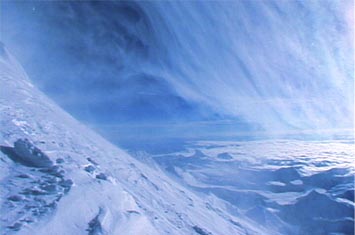 May 23 -24 Everest Summit Pyramid Extremely Cold, Windy and Dark
I’ve always wished life had a sound track. Then you would know when the music was getting louder that the killer was behind you raising his knife.
Just before we left our tent Puchhang changed out our O2 tanks for fresh ones. When he screwed on the Russian made regulator to my tank and opened the valve nothing happened. Pemba Tensing, the oth er man climbing with us, and I stared at Puchhang incredulously. I had used that regulator repeatedly with no problems. We were all a little hypoxic and although the importance of a bad regulator registered the solution or cause didn’t. Puchhang closed the valve and reopened it and something (probably ice) spit out the port and oxygen began to flow. Whatever the problem was it had resolved itself. Unfortunately that harmless problem (music plays on at same level) would greatly influence our thinking several hours later.
Pemba Tensing and I started across the rocky tent area to the base of the snow field where we clipped in and began moving up. Puchhang was still getting something straight away and said he would catch up. It would actually be several hours before he would catch up. Altitude is the great leveler and I was moving pretty fast (cue Rocky music including punch drunk look). Within a little while I had found a20sustainable rhythm – one breath one step. The two liters per minute was doing the trick. I remember thinking that I had been unable to call Terri before I left and I toyed with clever (at least in my hypoxic state) lines I could open with when I called. “Hey what you doing? I can see you from here!” etc.
Eventually the snow yields to a stretch of rock that is more scrambling than climbing. We were by ourselves on the mountain and although the rope went straight up I still had to find the easiest route and foot holds. Crampons are the best thing that ever happened for climbing on snow and ice but they make rock much more of a challenge and more painful. Every now and then I would look up which because of the steep angle required a real neck bend. Eventually, I saw that I was coming to the snow patch just below the “balcony” which represents the first O2 tank change over point and is just over half way to the summit. I felt great. The wind had dropped. I knew the sky would begin to lighten soon and that always warms the soul even more than the toes. I wasn’t going to be on the summit at daybreak as I had always hoped but I felt good about my decision to delay.
The new O2 mask we use has a plastic bottle that hangs down which allows you to see the oxygen flowing as a bag inside inflates and deflates. There is a carabineer that allows you to attach the bottle to your suit so it doesn’t swing around. Cue scary music. When we had walked out of the tent the wind was blowing so hard I was afraid the bottle would conk me in the head. I had been putting it in my parka on previous days but I was disinclined to unzip my parka even an inch to stuff the bottle in. Instead (music gets louder) I clipped it to my waist harness and complimented myself on my cleverness. One little issue with that – I soon discovered that when I bent my head back to look up there was not enough slack and my mask would be pulled down over my chin. In the dark, wind and cold that seemed like a minor nuisance. Cut to the dumb climber music and quick shot of inside of mask where ice is building every time I look up and expose the wet slimy inside of the mask to frigid wind.
Just below the “balcony” which is a little over the half way mark, I went from feeling on top of the mountain to feeling the mountain was on top of me. There is nothing scarier than to suddenly not be able to breathe. I was still inhaling but it didn’t seem to matter. I was clipped into the rope in a difficult section and I couldn’t seem to go more than a step every few minutes. Eventually Pemba and Puchhang pulled up beside me. Because of the earlier odd behavior of the regulator we all assumed it had failed. Puchhang and Pemba began to fiddle with it. We shut it on and off, banged on it, hit on the oxygen cylinder all to no avail – probably because there was nothing wrong with the regulator – although that is a testament to Russian engineering that we didn’t break it. During this time a commercial group of climbers had caught up with us. As the lead guy went by he looked at the motionless little bag in my plastic bottle and said “your oxygen system has failed”. I wanted to say “thanks Sherlock, I’m sitting here turning blue from cold and hypoxia with the mask hanging from my neck panting like a dying dog. What was your first clue?” But I didn’t have the breath.
At this point I had been without oxygen at somewhere close to 27,500 for a while. There are people (freaks of nature I think) who have climbed Everest without oxygen, but I wa sn’t in that league. I finally realized that Puchhang and Pemba were waiting for me to make some decision. I pulled out my repel device and told them I was going down. Pemba was more familiar with the mountain so I told him to come with me. I didn’t need them both so I told Puchhang he could go for the summit. This didn’t sit to well at first with Pemba but by then I was angry and wasn’t going to accept any dissent about descending. There was some words exchanged between the two but since it was in Sherpa I knew I was not going to get an argument.
I have no idea how long it took for me to get down without oxygen. I was now using the mask as a very expensive balaclava with it hanging at my chin. I do remember how scary it was rappelling in the dark. Usually you can look over your shoulder or down between your legs to see where you are going but with nothing but a flashlight strapped to your head there wasn’t much to be seen. I knew that each rope ended at an anchor point and a new rope started there so it was virtually impossible to get in real trouble but I had also crossed over the bergshrund (a big crevasse) and didn’t want go into it and have to climb out. Pemba would down climb each section and catch up with me as I moved my rappel device to the next rope. By the time it flattened enough that I could turn around and “arm rappel” (using your body to provide the friction to control your descent) the sky was beginning to lighten.
When I eventually tumbled into the tent the first thing I did was switch my tank to a different mask set up. It is amazing how quickly the O’s restore you. Within a couple of minutes I had a terrible thought. I grabbed my mask f rom the night before and rolled it over in my hand. Cue “I’m so dumb music”. Sure enough it was full of ice, frozen spit and snot with just a delicate frosting of rime. It is very difficult for gossamer thin silicone valves to open and close properly when they are covered in ICE. For a split second (before the fresh oxygen had eliminated all my hypoxia stupid) I thought “I can clean this out and go back up!” In hind sight and with the advantage of sat rates above 60% it is pretty obvious that I sewed the seeds of my own troubles when I clipped my bottle to my harness. Every time I looked up and pulled my mask down I was exposing the contents of to the freezing temps borne on the high winds. It was only a question of time. What is more the problem, we had been told what to do if the valves froze. This is not uncommon on very cold days up high. Unfortunately, because I didn’t have that sound track playing, I jumped to the immediate assumption that I had a regulator issue. We never, none of us, looked in the mask.
I crawled into my bag, turned up the oxygen and said a prayer for Puchhang, Bill and Mingma who were still up there. Then I thanked God I wasn’t a big sissy after all, just stupid.