


Base Camp
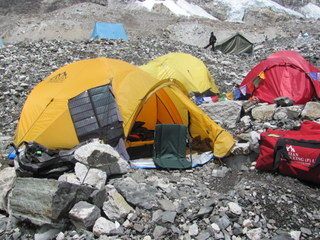
Arrived at Base Camp yesterday. It was only a four hike but it is up and down, up and down with the tents never seeming to get any closer. Last night was as I expected: temps in the teens, low saturation (sat) rates, racing pulse and general lethargy. Sat rate is the percentage of O2 in your blood. At sea level very high 90’s would be normal. Arriving at BC mine was in mid 70’s. At home that will get you an ambulance, here a shrug. I know I slept some because I can not remember the entire night. The problem is that as you sleep your respiration rate drops and your sat’s fall even more. At some point your body wakes you up asking “what are you doing fool?”
There are three main adaption techniques the body uses to adapt to altitude; increased respiration and heart rates, blood chemistry changes, and the creation of more red blood cells. The first is immediate and will gradually fall as the other two kick in. The second is your blood becomes more acidic. This allows it to take up more O2. Part of that process causes increased urination. Three or four times a night is normal for a well hydrated individual. If you do not want to climb out of a warm sleeping bag on multiple occasions through out the night you quickly learn to use a “pee-bottle”. The smart climber, including yours truly, makes sure you pick a bottle that can’t be confused with your water bottle. My personal favorite is the square Tupperware brand. It can be found on the “pee-bottle” aisle at any Walmart. There is a safety component to this as well. I am familiar with a climber who left his tent in the middle of the night at Camp 3, failed to clip in, slipped and fell to his death.
The third adaption, which takes weeks, is the creation of more red blood cells. This has its own draw backs however as a climber can easily become polysythemic (sp?) having to many red blood cells. This leads to blood sludging and poor perfusion including strokes. I know one climber who had a minor stroke on his second attempt. He brought a small test kit on his third attempt and when his hematocrit (red blood cell count) got to high he had a camp doctor drain a pint of blood and put back a pint of saline. He went on to summit a few days later. I personally think that is nuts but that is a good anecdote for what some are willing to do.
I learned that we have already suffered our first casualty on our team this year. A young man from Holland developed a bad cough here at BC before I even got here. There is a condition here called the Khumbu cough which is a form of cold induced bronchitis. It isn’t your “oh I’ll go see a doctor next week if this doesn’t clear up variety”. People have actually cracked their ribs from coughing so hard. He was evacuated by helicopter. He hopes to recover in KTM and rejoin the expedition. That is probably wishful thinking but he is a nice guy and I really hope he can. If not I hope he had trip insurance. At least half of climbing Everest is staying healthy.
Feel much better today. I will sort my gear and set up casa Bud for the next four to six weeks. I am not a particularity neat person but it makes living in tent so much easier. I walk by some tents and it looks like a bomb went of in an REI (climbing gear) store.